

 Introduction
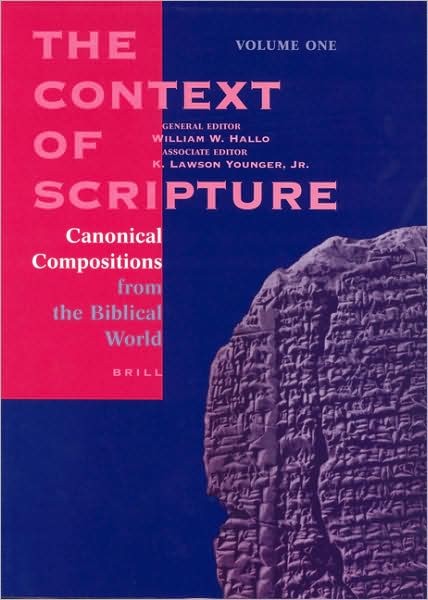
The study of the Hebrew Bible in the 20th century experienced a boost in its ability to understand countless passages that had previously been an enigma to modern scholarship. The archaeological finds of ancient Near Eastern (ANE) texts in the late 19th and 20th centuries supplied that boost. But for much of the 20th century these finds were not accessible to non-specialists including historians, anthropologists, seminary professors, students, pastors, and the lay enthusiast. William Hallo, the general editor of The Context of Scripture (COS), notes that these materials were “scattered in a bewildering variety of publications” (COS Vol. I p. xxv). Hallo explains that the volume edited by James B. Pritchard, Ancient Near Eastern Texts Relating to the Old Testament (ANET), was the first compendium in English to rectify this issue. Hallo acknowledges its place that it still holds in making texts available and accessible.
Although ANET is still valuable for the student of the ANE and Bible backgrounds (COS does not fully replace it), its last published edition dates to 1969. During the years following more discoveries were made, more previously discovered texts were translated for the first time, and old translations had been updated in various scholarly publications. A new compendium was needed. Hallo and Younger’s COS has met that need. In the Preface Hallo outlines the criteria used for selecting the texts to be included,
In their selection I was guided by a number of principles. Other things being equal (though they rarely are), preference was given to newly recovered or newly (re-)edited texts, though place was also made for some of the well-known older stand-bys; to texts able to be presented in their entirety; to well-preserved rather than fragmentary texts; and to texts whose relevance for biblical studies, by way either of comparison or of contrast, had been demonstrated or argued in the secondary literature. All four of these criteria were rarely met by any one text, and when they were, it was not always possible to find a translator for them. (COS, vol. 1, p xi)
The result of this selection process is a new compendium that gathers together the most relevant and important texts for comparative and background studies related to biblical studies.
Contents
One of the difficulties of doing comparative work is the classification of texts into genre types. COS takes what may be described as a “simplified” approach to understanding genre (Sparks, 15). It is “simplified” in that it divides text genres into three broad functional categories:
- Canonical Compositions – focus is on literary texts including myths, epics, hymns, prayers, laments, wisdom literature, love poems, etc.
- Monumental Inscriptions – focus is on inscriptions related to royalty, religion, building construction, etc.
- Archival Documents – focus is on economic and legal matters in letters, contracts, court cases, accounting texts, wills, etc.
In addition to containing the texts themselves, there are other things included as well. First, each text or series of texts has an introduction in which the translator summarizes the salient features of the text(s) and provides some background information to it. Second, each text has a short bibliography following it containing the main sources used. There is also a general bibliography following the major divisions within each volume (e.g., the “Egyptian Bibliography” following the “Egyptian Canonical Compositions” in vol. 1). Third, there are copious footnotes on translation issues and various significant interpretive issues within a text. And fourth, there are scripture references attached to various words, phrases, and concepts within the texts that represent a possible parallel to the Bible
Use
As is evident from the title, this work is intended to layout for the reader the context of Scripture. The context of Scripture is far-reaching including aspects of geography, topography, artifacts and buildings discovered in archaeology, and texts from the ANE. The last of these is arguably the most important and is the aspect that COS endeavors to make available.
The texts of the ANE are valuable for biblical studies for multiple reasons. They provide:
- data for the ANE and biblical chronologist
- further examples of a given biblical genre with similarities and differences that shed light on the biblical genre. One example of this is the work of Michael V. Fox comparing Egyptian love poetry to the Song of Songs. His work has revolutionized the study of and approach to the Song of Songs
- further examples of imagery used in the Bible that is unclear to the modern reader otherwise
- an understanding of ANE religion. There are countless references to ANE gods and religion in the Bible, but many of them are brief or assume the reader has a basic knowledge of a given religion; a basic knowledge that the modern reader does not have
- examples of cultural thinking, traditions, and practices
- data for understanding how people of the ANE communicate with one another whether in commerce, international relations, or war
- data for understanding how people of the ANE understood the world and the relationship between it and the gods.
How To Use
This Accordance module is completely integrated with the Accordance interface and search capabilities. The text is beautifully laid out and the appearance can be changed to however one chooses. The browser makes it easy to ‘thumb through’. It can also be searched in a variety ways whether by field (Reference, Title, Texts, Commentary, Footnotes, Editor/author, Bibliography) or by content (Transliteration, Scripture, Line Numbers, Greek content, Hebrew content, and page numbers).
Tips to follow while studying the Bible:
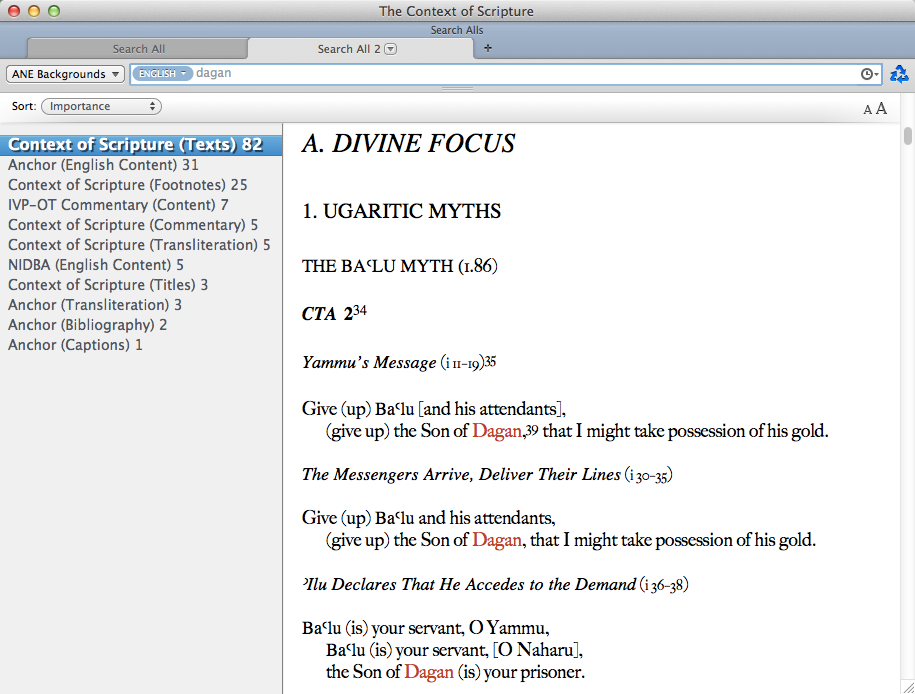
- Create a Search All group including only COS or a small group of modules including, for example, COS, AYBD, IVP Bible Backgrounds Commentary of the Old Testament, and the New International Dictionary of Biblical Archaeology in order to search select secondary literature at the same time.
- Do a Search All for the scripture reference you are studying.

- when you encounter the name of an ANE god or goddess, a person, or a place do a Search All in the aforementioned Search All group.
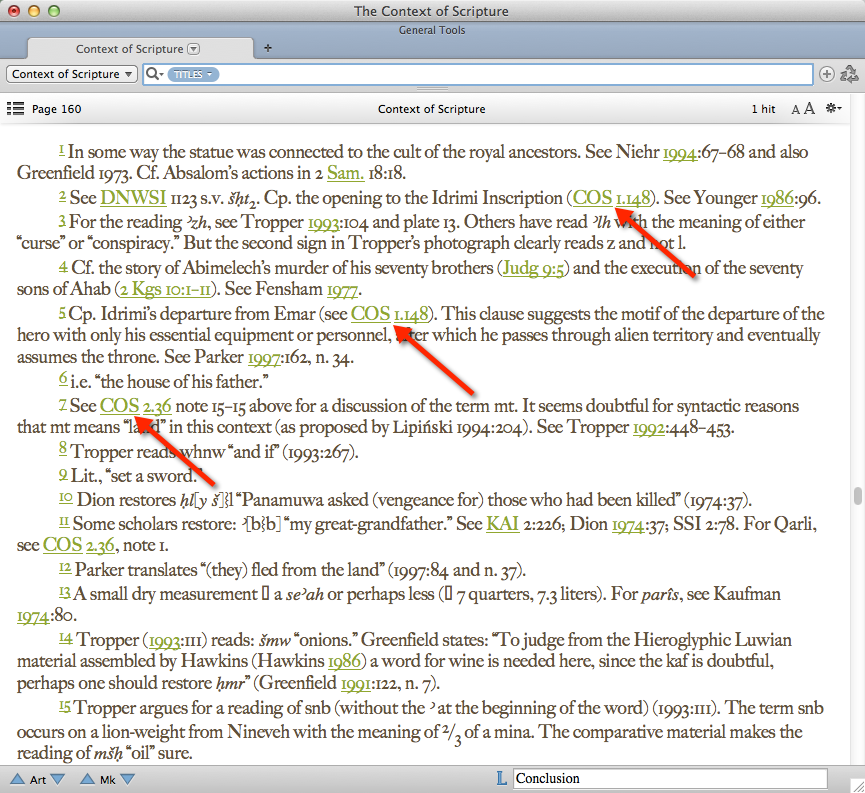
- While reading through an ANE text in COS, look for links to other texts in COS. There may be other texts that either should be read with the text you are reading or that provide helpful information (background or otherwise) to the text you are reading.
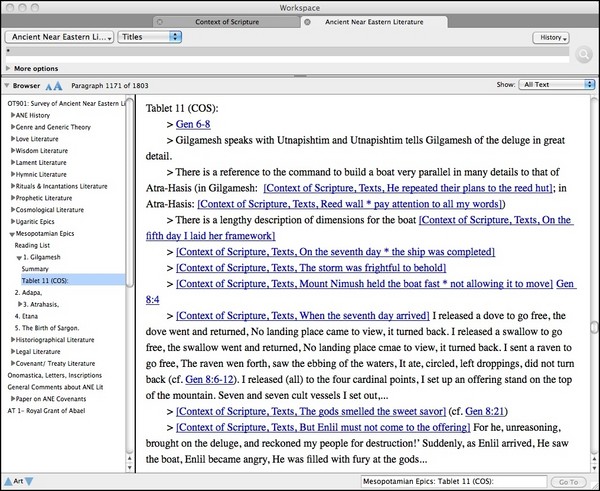
- After discovering a significant connection of a text or portion of a text to a biblical passage, create a link to it from your User Tool. If you are inclined to study ANE literature at some length or you intend to reference it continually in the future it would be worth creating a User Tool dedicated to your notes on this topic, which should then be included in your Search All group described above. See the screen shot below for an example of such a User Tool (the particular portion in the screen shot contains notes comparing Tablet 11 of the Epic of Gilgamesh to Atra-Hasis):
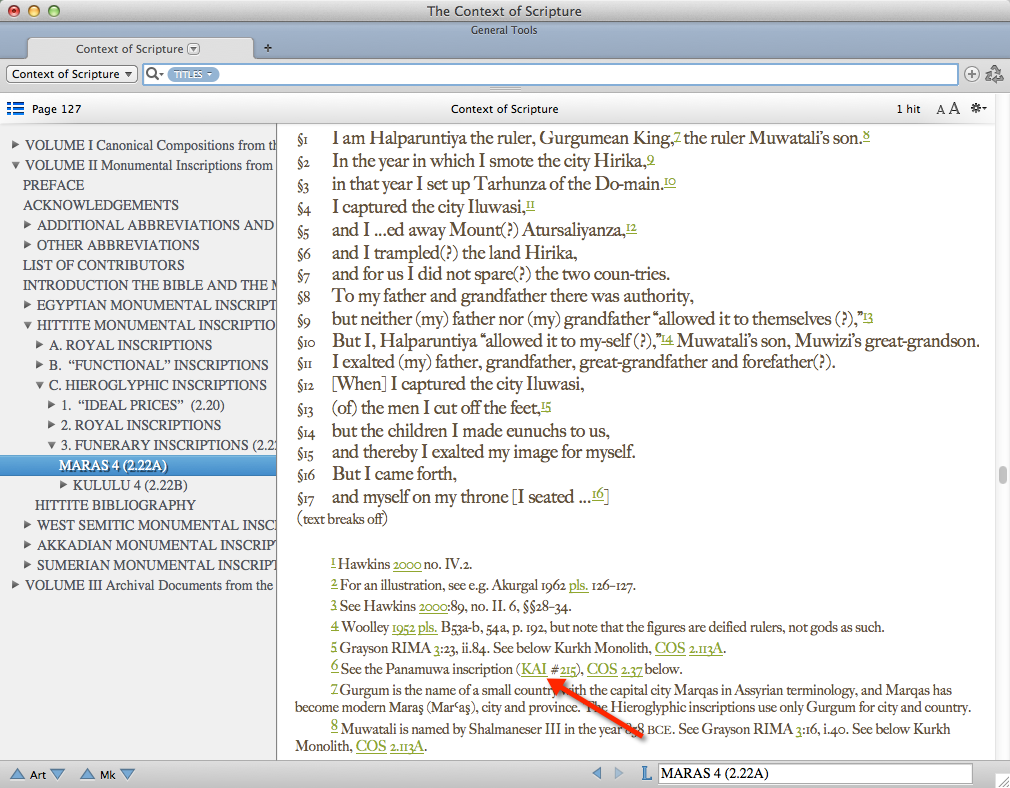
- For those who know Hebrew, Aramaic, Ugaritic, and/or various Canaanite dialects, the original language text of that found in COS can now be accessed directly from COS. There are over 1200 links to other Accordance original language modules within COS; namely, links to the Ugaritic Data Bank, Northwest Semitic Inscriptions (INSNWS), and Textbook of Aramaic Documents (TAD). For example, in COS 2.22A note 6 the KAI reference number is a link to INSNWS (the link is marked).

Conclusion
Just as 20th century biblical scholarship experienced a boost in its ability to understand the ANE context of the Bible through the discovery of ANE texts, so also 21st century biblical scholarship has experienced a boost in its ability to study these texts with speed, ease, and finesse. The Accordance module Context of Scripture is that boost.
For even more information, see this article.
Bibliography
- Fox, Michael V. The Song of Songs and the Ancient Egyptian Love Songs. Madison: University of Wisconsin Press, 1985.
- Pritchard, James B., ed. Ancient Near Eastern Texts Relating to the Old Testament with Supplement, 3rd ed. Princeton: Princeton University Press, 1969.
- Sparks, Kenton. Ancient Texts for the Study of the Hebrew Bible: A Guide to the Background Literature. Peabody, MA: Hendrickson, 2005.